
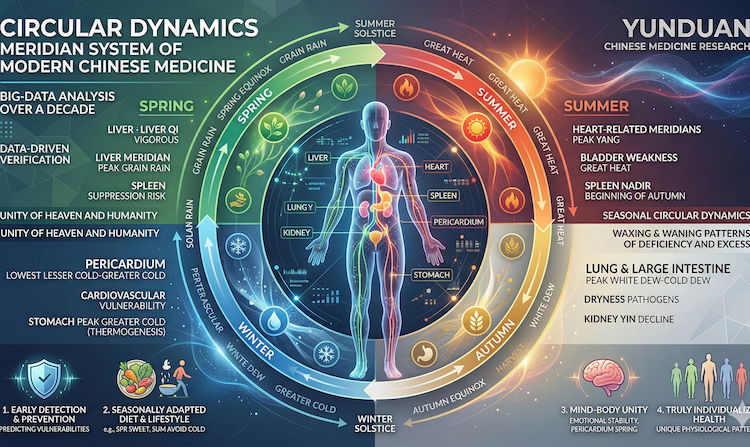
The Circular Dynamics Meridian System: A Data-Driven Seasonal Model of Preventive Chinese Medicine
Through more than a decade of big-data analysis, the CLOUDTCM research team has established the “Circular Dynamics Meridian System of Modern Chinese Medicine.”
This system demonstrates that the circulation of the human meridian network follows the same regulatory patterns as the 24 solar terms in nature, transforming classical Chinese medical philosophy into a visualized and precision-oriented model of preventive medicine.
1. Data-Driven Verification of Seasonal Change and the Unity of Heaven and Humanity
Quantitative analysis of modern meridian data confirms that the circulation of qi and blood in the human body resembles a microcosmic universe, exhibiting throughout the year a cyclic trajectory of alternating deficiency and excess, waxing and waning, consistent with the concept of circular motion.
Because meridian dynamics shift with seasonal change, identical symptoms (such as dizziness or headache) may arise from different etiologies in different seasons. Effective intervention must therefore be determined according to the prevailing seasonal meridian pattern. This constitutes the most precise model of individualized health cultivation and disease prevention.
2. Seasonal Circular Dynamics of Meridian Activity
Meridian energetics closely align with the natural rhythm of
spring engendering, summer flourishing, autumn harvesting, and winter storing:
- Spring (Wood ascendant and generating)
Liver qi becomes vigorous, with Liver meridian activity reaching its annual peak around Grain Rain. This predisposes to hyperactivity of Liver fire. Meanwhile, due to the Wood overacting on Earth relationship, the Spleen meridian may be suppressed, requiring attention to Liver–Spleen disharmony. - Summer (Fire exuberant and qi-consuming)
Heart-related meridians (Heart, Triple Burner, Small Intestine) display maximal yang activity. However, extreme heat and dampness increase systemic burden, causing the Spleen meridian to decline to its yearly nadir around Beginning of Autumn, while the Bladder meridian weakens markedly near Great Heat. - Autumn (Metal contracting and consolidating)
Lung and Large Intestine meridians reach peak activity between White Dew and Cold Dew, rendering them most susceptible to dryness pathogens. Meanwhile, Kidney energy, depleted by summer consumption, continues to decline, indicating the need to nourish yin and secure yang. - Winter (Water cold and storing)
The Pericardium meridian drops to its lowest level around Lesser Cold and Greater Cold, marking the period of greatest cardiovascular vulnerability. Kidney and Gallbladder meridians also reach profound deficiency.
In contrast, Stomach meridian activity peaks during the coldest phase (Greater Cold), reflecting the body’s instinct to enhance digestion and thermogenesis for cold resistance.
3. Inter-Meridian Coupling and Fixed Meridian Patterns
Changes in a single meridian often drive synchronous shifts in others (for instance, spring elevation of the Liver meridian commonly coincides with rising Stomach meridian activity), forming specific systemic meridian configurations.
For most individuals, these patterns are relatively stable and difficult to alter. Moreover, in the Northern Hemisphere each solar term corresponds to a characteristic meridian configuration. Health preservation therefore requires adapting to seasonal rhythms and natural law rather than resisting them.
4. Four Practical Health Applications of Modern Meridian Data
The core value of this system lies in guiding the public toward actionable strategies:
- Identifying Extremes and Treating Disease Before Its Onset
By predicting the solar terms during which organ defensive capacity is weakest (for example, the sharp winter decline of the Pericardium meridian), preventive measures such as early cold protection at the start of winter can reduce the risk of acute cardio-cerebrovascular events. - Seasonally Adapted Diet and Lifestyle Based on Deficiency–Excess Patterns
Data-informed living strategies may include:
spring moderation of sour flavors with increased sweet to protect the Spleen and Stomach;
avoidance of raw and cold foods in summer to safeguard the weakened Spleen meridian;
emphasis on moistening the Lung and nourishing yin in autumn;
and moderate supplementation with earlier sleep and later rising in winter. - Revealing the Psychophysiology of Mind–Body Unity
Meridian fluctuations directly reflect emotional tendencies. For example, the Pericardium meridian lies in a trough between Beginning of Spring and the Spring Equinox, predisposing to emotional instability and poor sleep.
Toward late spring, exuberant Liver qi may generate Liver fire; at this time, outdoor activity and emotional regulation often provide greater health benefit than medication. - Establishing a Truly Individualized Health System
Although big-data trends reveal general patterns, some individuals under chronic stress maintain a fixed “heat-dominant triangular meridian configuration” throughout the year. Such season-independent patterns are often the root of chronic disease.
Consequently, each person must return to self-observation and recognize their own unique physiological pattern in order to discover an effective path toward health improvement.

This Post Has 0 Comments